What's up with violence in video games?

I’ve never really had strong opinions about violence in video games. There might be a thought to be had about why so many people enjoy robbing gas stations in GTA, but, as many people much smarter than me have pointed out, I don’t think doing “morally bad” things in video games necessarily says anything about you as a person.
Sometimes, you just want to see where the story goes, and that means killing a bunch of civilians along the way. What interests me, though, is how that violence is framed.
By now, we’re probably all familiar with the classic revenge story. The hero’s family, friends, or fellow countrymen are killed or kidnapped by an invading force, and it’s up to them to defeat the enemy or save the princess. This kind of story has been done to death, likely because it’s one of the easiest ways to justify a protagonist going on a wild killing spree.
Since video games want to be seen as a serious form of storytelling, this narrative framing of violence is apparently necessary, accepted as such, and therefore very wide spread.
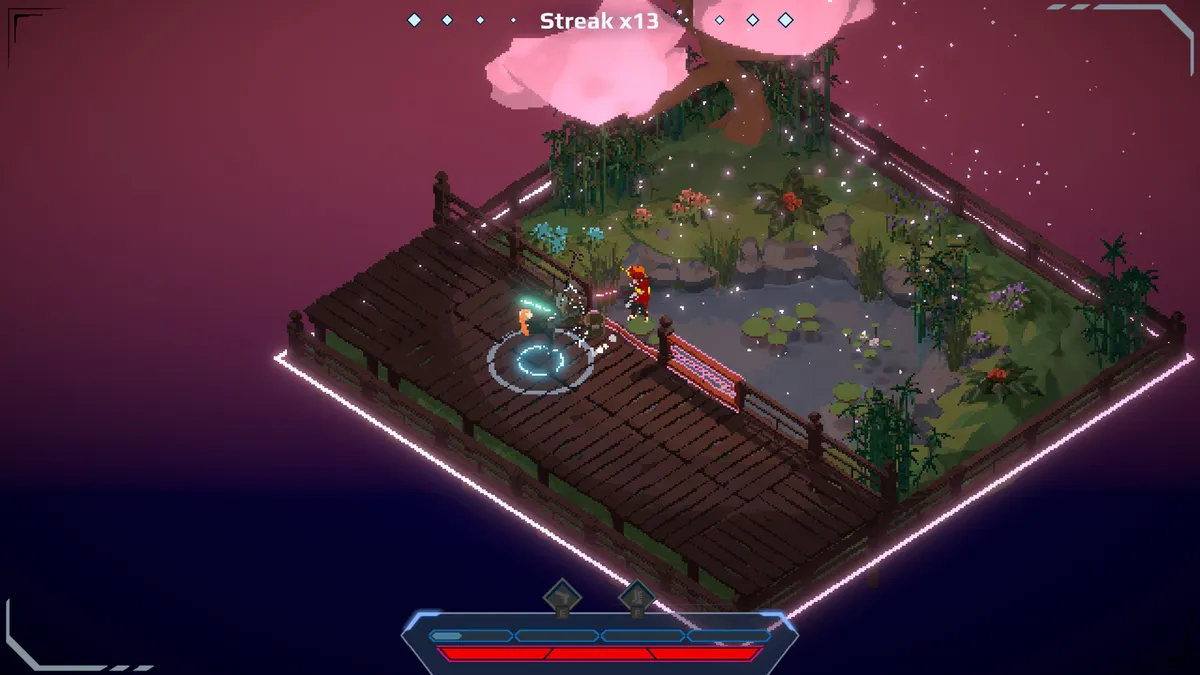
A couple of months ago, for example, I played a game called Disco Samurai, a rhythm game in which you take on the role of a stylish samurai woman who dodges, parries, slices, and shoots in time with the music. It executes its ideas well, though it isn’t normally the kind of game that would leave a strong impression on me.

The reason I’m still thinking about it months later, and why I’m now writing about it in an attempt to finally get it out of my head, is its narrative. The game also tries to justify its protagonist dropping people left and right through the story. In Disco Samurai, all the violence happens inside a video game.
There is the “real world,” where the protagonist lives with her dad and tries to make it as an artist, and then there is the world of Disco Samurai, a highly advanced VR game that she sometimes plugs into to solve a grand mystery and, naturally, show off her skills.
I find that deeply fascinating. The justification for violence in Disco Samurai is that it’s all just happening inside a game. Apparently, “it’s only a video game” is enough of a reason for violence to be happening, but only when the video game exists inside another video game.
I understand that developers today are very fond of the buzzword “immersion.” Therefore, the idea that “none of this is real” only works when there is a second, even less real layer inside the game itself. Still, I can’t help wondering whether games took a wrong turn somewhere along the way.
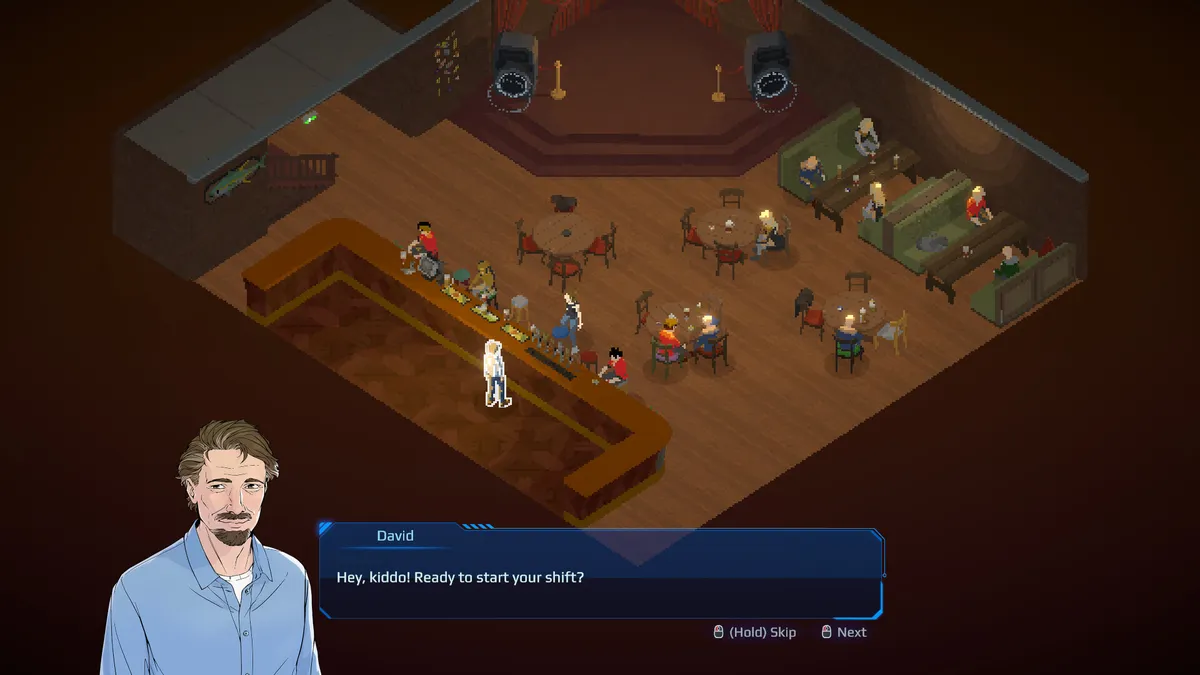
I’m not sure whether the developers of Disco Samurai consciously thought about this while making the game or whether it was just a happy little accident caused by the way games tend to be designed now. Either way, the whole thing seems a little silly to me.
Admittedly, I haven’t read enough Brecht or gone to the theater as often as I would like, but I think video games might be able to learn something from his approach to theater.
Occasionally reminding the audience that what they are experiencing is not real could open up new possibilities for storytelling. Games have not really explored those possibilities because so many developers seem to believe that immersion is necessary for a game to be effective.
Video games already borrow plenty of ideas from films. Personally, though, I think theater and video games may be more closely connected than many people realize. Brecht’s epic theatre remains influential in theatre culture, so I don’t see why games should not borrow some of its ideas as well.
People constantly repeat that video games are “art.” I don’t personally have a working definition of art yet, so I can’t contribute much to that particular debate. But if games are an art form, then one of their functions, among many others, can be to make people think about stuff.
Brecht’s approach to alienation could be especially effective in encouraging the audience, or in this case the player, to think critically about social and political issues. Games already do this, including highly “immersive” ones. However, I think there is often a layer of entertainment, identification, or emotional involvement that makes it difficult to apply what a game is saying to the real world.
As I’ve already said, I haven’t read or seen enough Brecht to formulate a proper theory here. I may return to the subject in the future, but I had to write something about Disco Samurai because the idea simply would not leave my head.
You should also definitely check out the game. The gameplay is good, I really like the art style, and, as you would expect from a rhythm game, the soundtrack absolutely slaps. Also, it’s about five hours long and costs roughly ten bucks on Steam.
If you have some spare change lying around and want to play something a little different, I wholeheartedly recommend it. Afterward, you can even tell me whether I’m full of shit when it comes to this amateur analysis of violence in video games—everybody wins.